

Two Rooms at yale Tsai CITY: Guhuza and Adaptation Lab This Fall
This fall, two SEESALT projects are working inside programmes at the Tsai Center for Innovative Thinking at Yale. They are at different stages and they ask different questions. Starting both in the same week has made it clear that they share a problem.
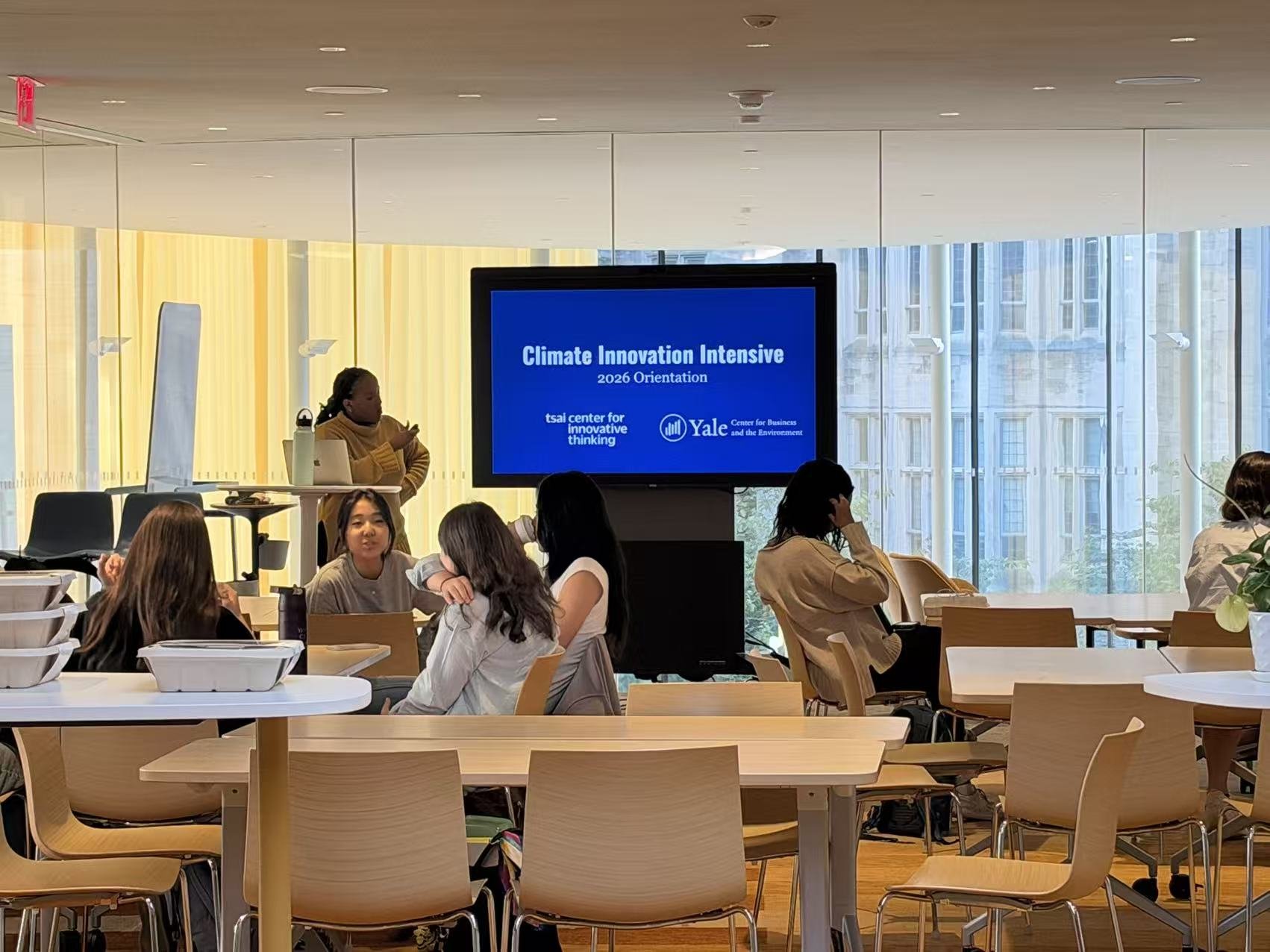
Climate Innovation Intensive 2026
Guhuza at Launch Pad
Guhuza is our peer-facilitated card game for talking about stigmatised health topics with young people in Rwanda. In July 2025, Rwandan student leaders ran it with roughly 330 participants in Kigali and Rwamagana, and forty decks stayed behind with four partner institutions. HIV is the first module; mental health is next.
This semester Guhuza is part of Tsai CITY’s Fall 2026 Launch Pad, a multi-week incubator for early-stage ventures built around workshops, mentoring and a cohort of student founders. The pilot left us with a specific gap. Three people at our partner sites have asked us back for more sessions, and we have no way yet to let them pay for one: no Rwandan entity that can invoice, and no price we have actually tested. Closing that gap is what the semester is for.
Mengyao Zhao, an MPH candidate in Social and Behavioral Sciences at the Yale School of Public Health, represents Guhuza in the Launch Pad cohort. Zhijun He and Xinyue Wen continue to co-direct the project. Read more about Guhuza.
Adaptation Lab at the Climate Innovation Intensive
Adaptation Lab is SEESALT’s work on climate adaptation in places recovering from conflict, disaster or resource extraction. It starts from a question that sounds technical and is not: how do the indicators that decide who qualifies for adaptation and development finance get made, and what happens to the places that do not fit them?
This fall the Lab is taking part in the Climate Innovation Intensive, a six-week cohort run jointly by Tsai CITY and the Yale Center for Business and the Environment. Sessions run on Wednesday evenings through a final showcase on 11 November.
The Intensive opened on 30 September with a lecture by Julie Zimmerman, Yale’s Vice Provost for Planetary Solutions, who leads the university-wide Planetary Solutions Project. Her examples came from green chemistry and engineering: a harmful chemical replaced by a substitute that turns out to be just as harmful, a fix in one place that quietly shifts the burden somewhere else, an efficiency gain that only speeds up a system heading in the wrong direction. Her point was that most of these failures are written into the problem statement before anyone builds anything.
Anthropologists have a name for one version of this. Tania Li calls it rendering technical: a problem is narrowed until it fits the solution already on offer, and the parts that do not fit drop out of view. Adaptation Lab exists to study that move in climate finance, where an eligibility indicator can make a country legible to a funder while shifting the cost of adaptation onto the people least able to carry it. Read more about Adaptation Lab.
What the two have in common
Guhuza and Adaptation Lab look as if they belong to different worlds: one is a deck of cards in a Rwandan classroom, the other is research on how development finance gets allocated. Both start from the same observation. Health education in Rwanda has largely won the information battle; young people know the facts about HIV. The barrier that remained was social, and a campaign built to deliver information could not see it. An indicator built to measure climate need can miss the same kind of thing.
Yale’s Planetary Solutions effort rests on the idea that climate change, biodiversity loss and their social consequences cannot be solved one discipline at a time. We agree, and we would add one thing: the social sciences are most useful at the beginning, when the problem is still being defined, rather than at the end, when a finished solution needs a community to accept it. That is the contribution SEESALT is trying to make in both rooms this fall.
If you are at Yale and working on adolescent health, climate adaptation or development finance, we would be glad to talk. You can reach us through the SEESALT site.
